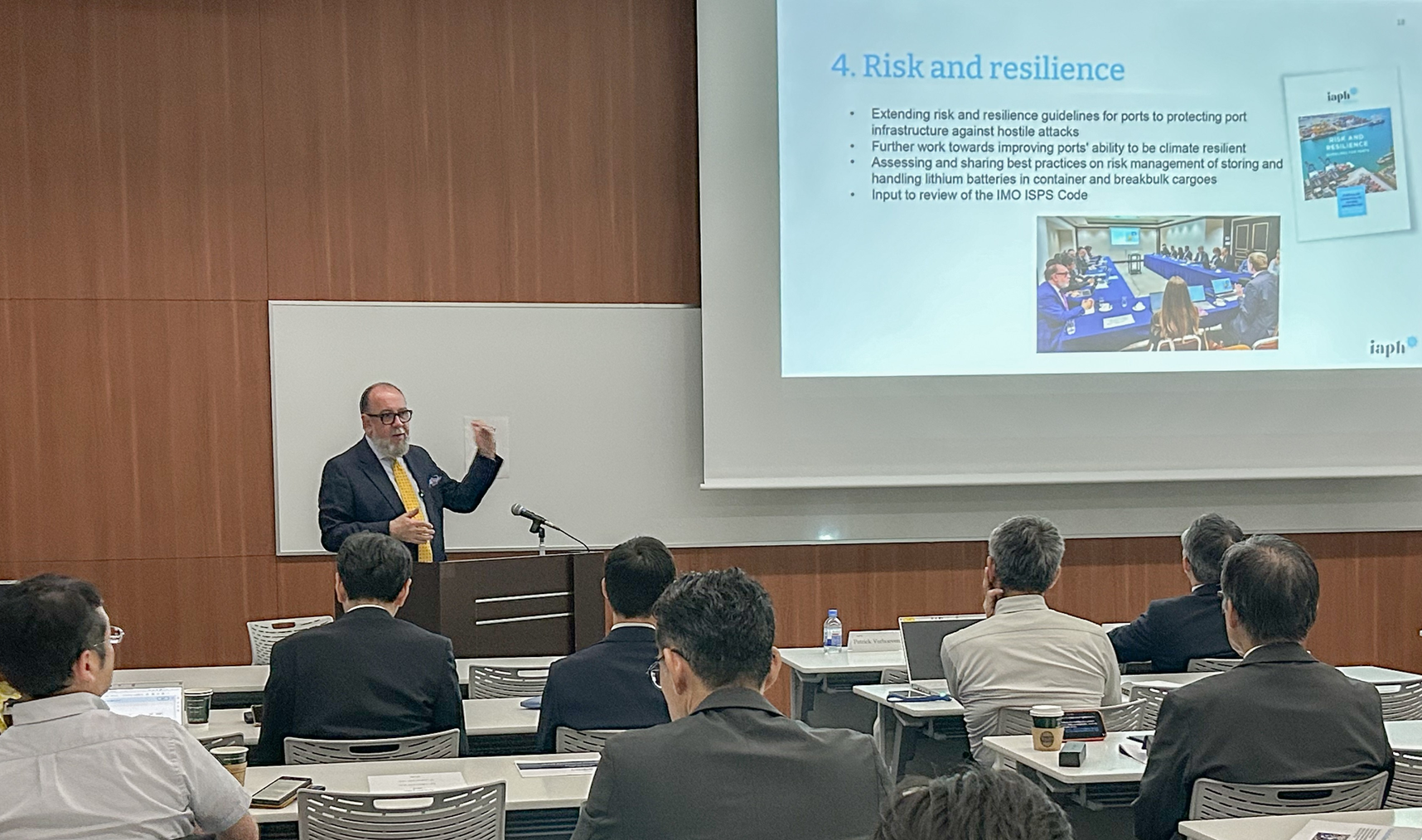
A dedicated seminar to encourage Japanese members to actively contribute to the work of the IAPH technical committees was held in Tokyo on 18 September. Organized by IAPH, the Japanese Foundation for IAPH and the IAPH Japanese Society, the seminar brought together approximately 40 attendees representing IAPH member ports in Japan; AI-powered simultaneous translation was used to support communication.
The event opened with remarks from Ichio Motono, IAPH vice-president for Asia, South/West, East & Middle East, who has been engaging with major Japanese ports to encourage greater participation by younger staff in IAPH’s technical committees.
Patrick Verhoeven, managing director of IAPH, then provided a presentation introducing IAPH’s technical committees and their contribution to addressing the key challenges facing ports worldwide.
With more than 400 members globally, IAPH brings together port authorities and other stakeholders to facilitate international cooperation and the exchange of knowledge and experience. Patrick described the technical committees as the “engine room” of IAPH, providing a platform for members to exchange information, develop practical guidance and tools, and address issues of common interest. IAPH currently has five active technical committees covering Climate and Energy; Data Collaboration; Risk and Resilience; as well as Cruise; and Planning, Operations and Finance.
The presentation highlighted a broad range of issues shaping the port sector, including decarbonization, alternative marine fuels, onshore power supply (OPS), digitalization, cybersecurity, port call optimization, and resilience. With no single alternative marine fuel having yet emerged as the clear long-term solution, Patrick noted that ports should prepare for a “multifuel future” and respond to the evolving requirements of the shipping industry.
Patrick also introduced several IAPH initiatives and practical resources supporting ports in these areas, including the Environmental Ship Index, the Clean Marine Fuels toolkit, and the Port Readiness Level tool. In addition, the World Port Sustainability Program provides an online portfolio through which ports can share projects, experiences and good practices with the international port community.
The subsequent Q&A session provided an opportunity to discuss issues of particular relevance to ports in Japan and Asia. Participants raised questions concerning access to technical committee information, sustainability accreditation for cruise terminals, the different stages of port digitalization, and opportunities for greater participation by Asian ports. Patrick explained that meeting recordings, summary records, webinars and increasingly AI-supported summaries are available to help members access information efficiently, while encouraging members to focus on topics most relevant to their respective organizations.
The discussion also addressed climate resilience, including sea-level rises, flooding and other long-term impacts on port infrastructure. Patrick noted that a working group under the Risk and Resilience Committee is developing guidance on climate change impacts and encouraged Japanese ports to contribute their experience and expertise to this work.
The seminar underscored the importance of continued international cooperation in addressing the complex and rapidly evolving challenges facing the port sector. Patrick encouraged Japanese and other Asian port stakeholders to actively engage in IAPH’s technical committees and to bring regional experiences and common challenges to the international discussion.